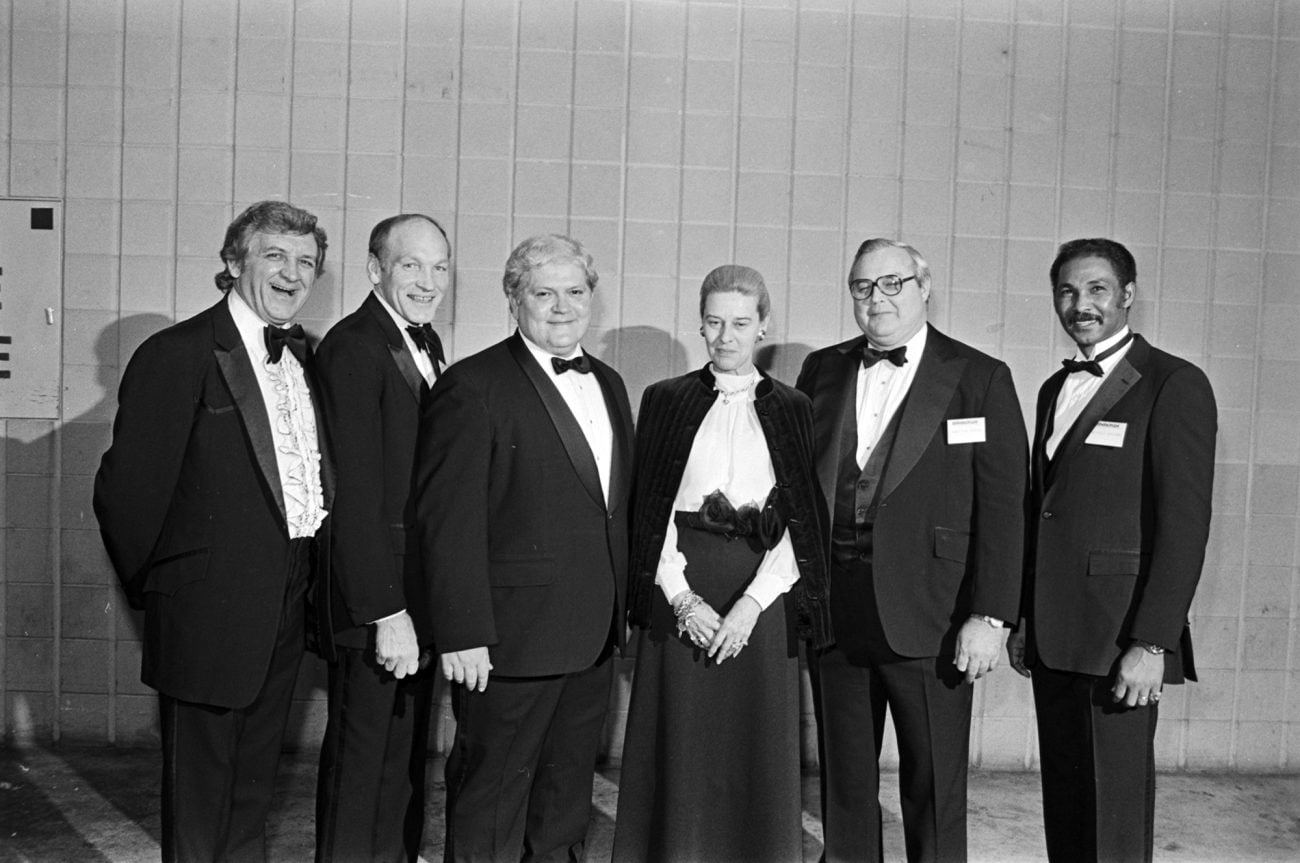
Maxie Baughan Jr.
Greene County native Maxie Baughan Jr. (1938-2023) was a star football player for the Georgia Institute of Technology (Georgia Tech) and in the National Football League (NFL) with the Philadelphia Eagles and the Los Angeles Rams, earning him nine Pro Bowl appearances. After his retirement, he became a football coach for college and professional football teams. Baughan was inducted into the Alabama Sports Hall of Fame in 1983.
Maxie Callaway Baughan Jr. was born on August 3, 1938, in Forkland, Greene County. Baughan’s father, Maxie Callaway Baughan Sr., was a sharecropper and, later, a telephone lineman, and his mother, Minnie (Greene) Baughan, was a homemaker. Baughan grew up in Bessemer, Jefferson County. He was active in the Boy Scouts, and he earned the rank of Eagle Scout, the highest rank in the program. Baughan attended Bessemer High School, where he starred in football, track, and basketball. He graduated in 1956 and was aggressively recruited by the Georgia Tech Yellow Jackets.
Baughan played football for the Yellow Jackets from 1957 to 1959 and was a star two-way player, meaning he played both offense (center) and defense (linebacker). He was active in almost every play of each game. In 1959, Baughan was named Georgia Tech’s team captain; he was also selected as the 1959 Southeastern Conference Lineman of the Year and as a consensus All-American for his excellent defense. (A consensus All-American is an athlete who has been voted as a top player by a minimum of half of the organizations that select the best players.) Baughan set a Georgia Tech record in 1959 for most tackles in a season with 124. In January 1960, Baughan was named co-MVP of the Gator Bowl even though his team lost to the University of Arkansas. Baughan graduated from Georgia Tech in 1960 with an industrial engineering degree. Although he was considered small for a linebacker at 6 feet, 1 inch, and around 225 pounds, professional teams were interested in signing him.
Baughan was drafted in the second round (twentieth overall selection) by the Philadelphia Eagles in the NFL’s 1960 draft. He was also selected in the first round by the Oakland Raiders (present-day Las Vegas Raiders) in the American Football League’s (AFL’s) inaugural 1960 draft. Baughan chose the established Eagles and NFL over the Raiders, who had never played a game in the new and untested AFL.
When Baughan played his first exhibition game for the Eagles in 1960, he immediately won his teammates’ respect. After San Francisco 49ers running back Hugh McElhenny kicked Eagles defensive tackle Ed Khayat in the head while Khayat was on the ground, Baughan chased McElhenny across the field, tackled him, ripped off his helmet, and punched him repeatedly in the head. The altercation led to a violent brawl between the 49ers and Eagles. The Eagles players admired Baughan for standing up for a teammate, and he became a popular member of the team. Baughan was soon named a starter. The Eagles won the NFL championship in his first year, defeating the Green Bay Packers, 17-13. Baughan was the runner-up for the 1960 Rookie of the Year. He was named to the first of five Pro Bowl selections with the Eagles, who then struggled through four losing seasons following the championship. Baughan married Dianne Edge Baughan in 1961. The couple would have three sons.
After the 1965 season, Baughan was traded to the Los Angeles Rams, for whom he played from 1966 to 1970. Rams coach George Allen admired Baughan and made him defensive team captain and the signal caller on defense. Baughan played well for the very competitive Rams, who made the playoffs in 1967 and 1969. Though the team lost those playoff games and the opportunity to play for the NFL Championship, they were victorious in the Playoff Bowl, a little-remembered game played for third place; they defeated the Cleveland Browns 30-6 and the Dallas Cowboys 31-0, respectively. He was selected to the Pro Bowl in his first four years with the team before retiring in 1970 because of injuries.
Baughan then moved into coaching, serving as defensive coordinator for Georgia Tech from 1972 to 1973. In 1974, George Allen, who had since become the coach for the Washington Redskins (present-day Washington Commanders), convinced Baughan to come out of retirement and become a player-coach for the Redskins. Though Baughan played in just two games in the 1974 season, both were victories and helped Washington gain a playoff spot, and he retired again at the end of the season. Baughan then coached for the Baltimore Colts (present-day Indianapolis Colts) from 1975 to 1979 and the Detroit Lions from 1980 to 1982.
In 1982, Baughan then returned to the collegiate ranks as Cornell University’s head coach, serving until 1988. Cornell’s Big Red football team had been unsuccessful for many years, but Baughan transformed it into a winning squad. In 1986, Big Red had a successful 8-2 record, finishing second in the Ivy League football division. In 1988, Cornell won only its second Ivy League Championship (technically, they shared the championship with the University of Pennsylvania’s football team), with Baughan leading them to a 7-2-1 record. Cornell’s only previous championship had been in 1971. Cornell fans were excited about their football team’s success, but that changed abruptly when Baughan was pressured to resign in April 1989 after his long-term romantic relationship with Cathy Noyes, the wife of Baughan’s assistant head coach, Peter Noyes, was made public.
Baughan then coached football in Japan in 1989 but soon returned to the NFL as linebacker coach for the Minnesota Vikings (1990-91), the Tampa Bay Buccaneers (1992-95), and the Baltimore Ravens (1996-98). As the Ravens’ coach, he mentored Baltimore linebacker and superstar Ray Lewis.
For his accomplishments, Baughan was inducted into the Georgia Tech Hall of Fame (1965), the Georgia Sports Hall of Fame (1980), the Alabama Sports Hall of Fame (1983), the College Football Hall of Fame (1988), the Philadelphia Sports Hall of Fame (2012), and the Philadelphia Eagles’ Hall of Fame (2015). Baughan was selected to the Pro Bowl nine times in 12 NFL seasons.
Baughan was active with the Boys Scouts for many years, and he earned the Eagle Scout. He earned the Distinguished Eagle Scout Award in 2012 for his many years of service to scouting.
Baughan died on August 19, 2023, in Ithaca, New York, at age 85. A year later, his family indicated, through the Concussion Legacy Foundation, that Baughan’s autopsy revealed stage 3 Chronic Traumatic Encephalopathy (CTE). CTE, a degenerative brain illness, derives from numerous instances of powerful impacts to the head, leading to brain trauma, and is common in football players.