David Moniac
David Moniac (ca. 1802-1836), Creek Indian of mixed ancestry and grand-nephew of Creek leader Alexander McGillivray, was one of the earliest ethnic minorities to graduate from the United States Military Academy at West Point and the first cadet appointed from Alabama. Moniac also had the distinction of being the only Native American commissioned as an officer during the Second Seminole War. He was killed in action during that war at the Battle of Wahoo Swamp, Sumter County, Florida.
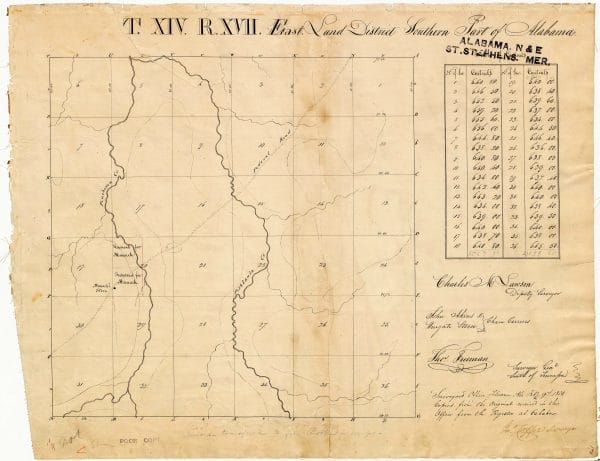 Map of Manack Store
Moniac (sometimes listed as David A. Moniac) was born on December 25, most likely in 1802, to mixed-ancestry Creek parents Sam Moniac (also spelled Manack) and Elizabeth Weatherford (sister of Creek leader William Weatherford) near Pinchona Creek in present-day Montgomery County. Sam owned a store and tavern that catered to travelers on the Federal Road. Little is known of David’s early life, but he is descended from and related to many important figures of the Creek Wind Clan, although biographical pieces likely include much speculation rather than fact. Sam Moniac served as a guide to the U.S. military during the Creek War of 1813-14, and in 1817 David was admitted to West Point, likely as a gesture of repayment for his father’s service. Prior to entering the academy, Moniac traveled to Washington, D.C., to study with a tutor named John McLeod in preparation for West Point’s entrance examinations and curriculum.
Map of Manack Store
Moniac (sometimes listed as David A. Moniac) was born on December 25, most likely in 1802, to mixed-ancestry Creek parents Sam Moniac (also spelled Manack) and Elizabeth Weatherford (sister of Creek leader William Weatherford) near Pinchona Creek in present-day Montgomery County. Sam owned a store and tavern that catered to travelers on the Federal Road. Little is known of David’s early life, but he is descended from and related to many important figures of the Creek Wind Clan, although biographical pieces likely include much speculation rather than fact. Sam Moniac served as a guide to the U.S. military during the Creek War of 1813-14, and in 1817 David was admitted to West Point, likely as a gesture of repayment for his father’s service. Prior to entering the academy, Moniac traveled to Washington, D.C., to study with a tutor named John McLeod in preparation for West Point’s entrance examinations and curriculum.
Moniac was in every respect a traditional Creek. His presence in the Corps of Cadets was a novelty, although his physical appearance did not distinguish him from fellow cadets. He graduated in 1822, 39th in a class of 40, after being “turned back” (having to repeat a year) at his own request. Upon graduation, he was commissioned brevet second lieutenant in the Sixth U.S. Infantry Regiment. He resigned before reporting for duty, however, while on authorized graduation leave. His resignation was probably prompted by an 1822 letter from his uncle David Tate indicating that his father had become destitute and was drinking heavily. The family was thus in need of someone to manage the clan’s property.
Moniac returned to Alabama, settling at Little River in Baldwin County, where he farmed cotton and bred thoroughbred race horses. He married Mary Powell in the 1820s, and the couple would have a daughter. His first of two episodes of military service came in 1836, when he served in the Alabama militia under Gen. Thomas Sidney Jesup in suppressing an uprising of displaced Creeks. Later that year, he was the only Native American to hold a commissioned officer’s rank during the Second Seminole War, that of major in the all-Creek Regiment of Mounted Volunteers. He was killed in the Battle of Wahoo Swamp (in present-day Sumter County, Florida) while attempting to inspire and lead Creek militiamen across a swamp in the face of fierce small-arms fire from Seminole warriors. His death effectively ended the day’s battle. His body was recovered and interred alongside the victims of the subsequent Dade’s Massacre, in which the Seminoles soundly defeated the forces of Maj. Francis Dade. In 1842, Moniac’s body was likely moved to Florida National Cemetery near St. Augustine. His descendants remained in Baldwin County, where his only son, David A. Moniac, served as sheriff.
Further Reading
- Griffin, Benjamin. “Lt. David Moniac, Creek Indian: First Minority Graduate of West Point.” Alabama Historical Quarterly 2 (Summer 1981): 99–110.
- Hauptman, Laurence, and Dixon Heriberto. “Cadet David Moniac: A Creek Indian’s Schooling at West Point, 1817–1822.” Proceedings of the American Philosophical Society 152 (September 2008): 322-48.