Mary Morgan Keipp
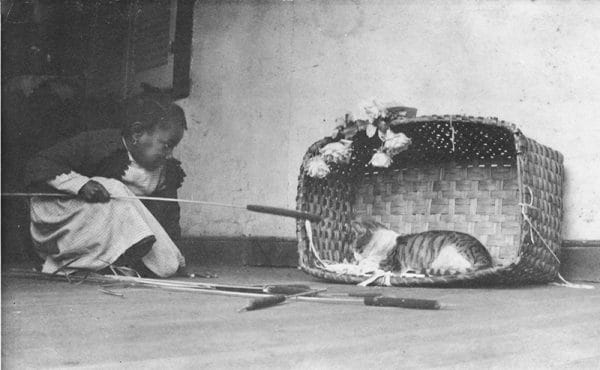 Girl with Cattail and Cat
Mary Morgan Keipp (1875-1961), a native of Selma, Dallas County, was an important figure in the art photography movement of the early twentieth century. Although known internationally for her photographs of African Americans in the Black Belt, Alabamians did not discover her work until after her death. In an era when most Alabama amateurs photographed for their own pleasure, Mary Morgan Keipp (pronounced “kip”) produced a body of photographs of rural African American life that would be shown at some of the most prestigious exhibitions in America and England.
Girl with Cattail and Cat
Mary Morgan Keipp (1875-1961), a native of Selma, Dallas County, was an important figure in the art photography movement of the early twentieth century. Although known internationally for her photographs of African Americans in the Black Belt, Alabamians did not discover her work until after her death. In an era when most Alabama amateurs photographed for their own pleasure, Mary Morgan Keipp (pronounced “kip”) produced a body of photographs of rural African American life that would be shown at some of the most prestigious exhibitions in America and England.
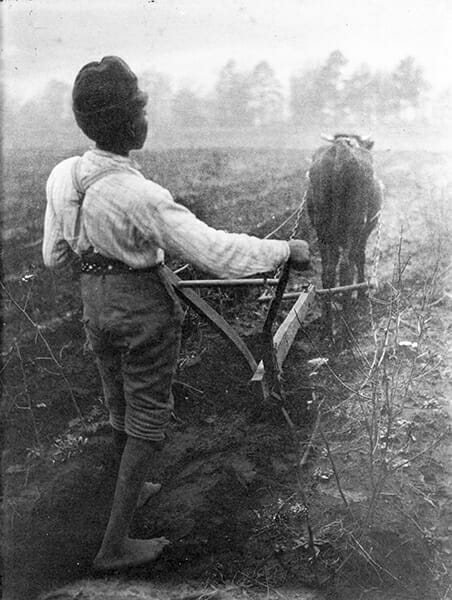 Boy Plowing a Field
Born on October 25, 1875, at the end of the Reconstruction era to a southern-born mother and a German-immigrant father, Keipp was professionally educated as a nurse-anesthetist in the Northeast, an unusual opportunity for a woman of her upbringing in that era. Between 1899 and 1904, she exhibited photographs that she had taken on visits home to Selma at seven major art exhibitions in New York, London, Philadelphia, Pittsburgh, and Washington, D.C. She exhibited with international artists and art photography luminaries such as Alfred Stieglitz, Edward Steichen, and Thomas Eakins, and her group exhibition venues were among the most prestigious for art photography at the time: the New York Camera Club (December 1899); Dudley Galleries (London, October 1901); the Fourth Annual Photographic Salon (November 1900); the Philadelphia Academy of Fine Arts; and the National Arts Club of New York Photo-Secession Exhibition (1902), organized by Alfred Stieglitz.
Boy Plowing a Field
Born on October 25, 1875, at the end of the Reconstruction era to a southern-born mother and a German-immigrant father, Keipp was professionally educated as a nurse-anesthetist in the Northeast, an unusual opportunity for a woman of her upbringing in that era. Between 1899 and 1904, she exhibited photographs that she had taken on visits home to Selma at seven major art exhibitions in New York, London, Philadelphia, Pittsburgh, and Washington, D.C. She exhibited with international artists and art photography luminaries such as Alfred Stieglitz, Edward Steichen, and Thomas Eakins, and her group exhibition venues were among the most prestigious for art photography at the time: the New York Camera Club (December 1899); Dudley Galleries (London, October 1901); the Fourth Annual Photographic Salon (November 1900); the Philadelphia Academy of Fine Arts; and the National Arts Club of New York Photo-Secession Exhibition (1902), organized by Alfred Stieglitz.
In 1904, Keipp returned to Selma permanently to pursue her nursing career, eventually working as an anesthetist in association with King Memorial and Selma Baptist hospitals. With her distance from major art centers and the decline of the art photography movement, Keipp ceased to exhibit her work.
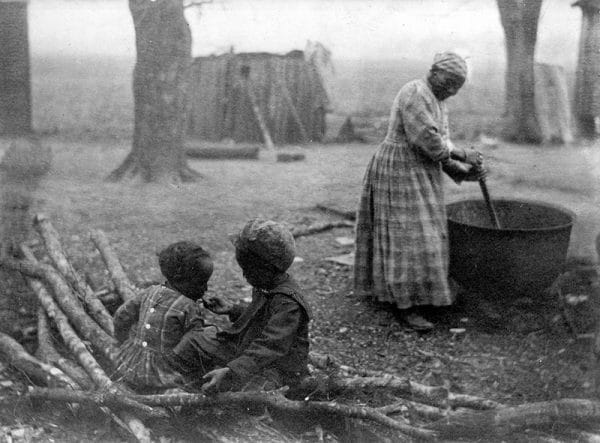 Doing the Wash
Keipp came of age during a period of profound social and economic change in the Black Belt, an era in which Jim Crow segregation laws created formidable barriers between whites and African Americans. Despite the prevailing social environment, her photographs show an interest in and empathy for black Alabamians, perhaps because she, as a single woman in a profession, was something of an outsider as well. Keipp’s work in a healing profession and her family’s neighborliness also may have helped engender trust between herself and the African Americans she photographed. Indeed, a group of black women who operated a small open-air market next to the Keipp home took shelter with their children on the Keipp’s back porch each evening until wagons arrived to take them to their rural homes.
Doing the Wash
Keipp came of age during a period of profound social and economic change in the Black Belt, an era in which Jim Crow segregation laws created formidable barriers between whites and African Americans. Despite the prevailing social environment, her photographs show an interest in and empathy for black Alabamians, perhaps because she, as a single woman in a profession, was something of an outsider as well. Keipp’s work in a healing profession and her family’s neighborliness also may have helped engender trust between herself and the African Americans she photographed. Indeed, a group of black women who operated a small open-air market next to the Keipp home took shelter with their children on the Keipp’s back porch each evening until wagons arrived to take them to their rural homes.
Most of Keipp’s surviving photographs are impressionistic, soft-focus genre scenes. Some have inscribed titles indicating that they were intended for exhibition. The majority of Keipp’s art photographs depict people engaged in day-to-day personal activities on porches, in yards, and in scrub woodlands. Her subjects, mostly women and children, boil the family washing, fetch water, churn butter, tend children, pause to hold a weary baby, exult over a giant gourd, play a homemade musical instrument, or rest against a spinning wheel. A few photographs depict individuals working in large cotton fields as tenant farmers or day laborers for white landowners.
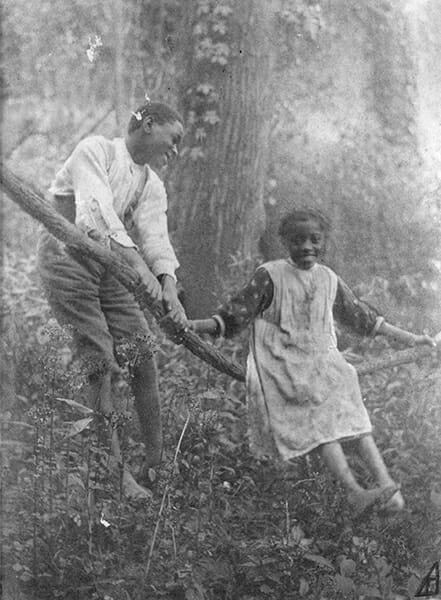 Grapevine Swing
In one image, a girl swings on a vine as a boy pushes her to and fro. Their simple pleasure animates the Black Belt woodland. At ease before Keipp’s lens, the smiling girl invites viewers to share her joy. Two platinum prints of this image survive, one in the Selma Depot Museum, the other in the National Museum of American Art, Smithsonian Institution, Washington, D.C. The strength and power of such images results from photography’s credibility, which creates a convincing particularity. These images are unique in Keipp’s generation. No other photographer of the era working in Alabama penetrated so deeply with the evident consent of her African American subjects into their rural domestic activities and lives. She responded by depicting them as strong, energetic, stoic, self-sufficient, familial, and visually interesting.
Grapevine Swing
In one image, a girl swings on a vine as a boy pushes her to and fro. Their simple pleasure animates the Black Belt woodland. At ease before Keipp’s lens, the smiling girl invites viewers to share her joy. Two platinum prints of this image survive, one in the Selma Depot Museum, the other in the National Museum of American Art, Smithsonian Institution, Washington, D.C. The strength and power of such images results from photography’s credibility, which creates a convincing particularity. These images are unique in Keipp’s generation. No other photographer of the era working in Alabama penetrated so deeply with the evident consent of her African American subjects into their rural domestic activities and lives. She responded by depicting them as strong, energetic, stoic, self-sufficient, familial, and visually interesting.
 Churning Butter
Although some of Keipp’s photographs were publicly exhibited and probably interpreted across a spectrum of racial attitudes, no denigrating elements are evident in her work. Because her photographic activity was not reported in Selma newspapers and was completely unknown outside her family at her death, her images were apparently not intended to influence Alabamians’ ideas about race and culture. Instead, they are most appropriately viewed as Keipp’s personal appreciation of rural and small-town Alabama life and a means of artistic and perhaps social discovery.
Churning Butter
Although some of Keipp’s photographs were publicly exhibited and probably interpreted across a spectrum of racial attitudes, no denigrating elements are evident in her work. Because her photographic activity was not reported in Selma newspapers and was completely unknown outside her family at her death, her images were apparently not intended to influence Alabamians’ ideas about race and culture. Instead, they are most appropriately viewed as Keipp’s personal appreciation of rural and small-town Alabama life and a means of artistic and perhaps social discovery.
The majority of Keipp’s surviving works (43 images, a mixture of exhibition-quality and work prints) are at the Selma Depot Museum. Two monogrammed exhibition-quality prints are in the National Museum of American Art, Smithsonian Institution, Washington, D.C., another is part of a private Alabama collection, and a small, handmade book of her photographs is in the New York Public Library.
Additional Resources
Catalogue of Fourth Philadelphia Photographic Salon, November 18–December 14, 1901, catalog no. 161.
Foresta, Merry A. American Photographs: The First Century from the Isaacs Collection in the National Museum of American Art. Washington, D.C.: National Museum of American Art, 1996.
Robb, Frances Osborn. “Engraved by the Sunbeams.” In Made in Alabama: A State Legacy, edited by E. Bryding Adams. Birmingham, Ala.: Birmingham Museum of Art, 1995.
——— Shot in Alabama: A History of Photography, 1839-1941, and a List of Photographs. Tuscaloosa: University of Alabama Press, 2016.
Taylor, Herbert W. “The 1901 London Salon.” Photo Era 7 (November 1901): 200.
———. “Fourth Philadelphia Photographic Salon.” Photo Era 7 (December 1901): 212.